What Will WhatsApp API Messages Cost in Bangladesh from October 2026?
A customer asks about a course. Your adviser sends the fees, class times and booking link in three replies. From October, those helpful replies may add to your WhatsApp bill.
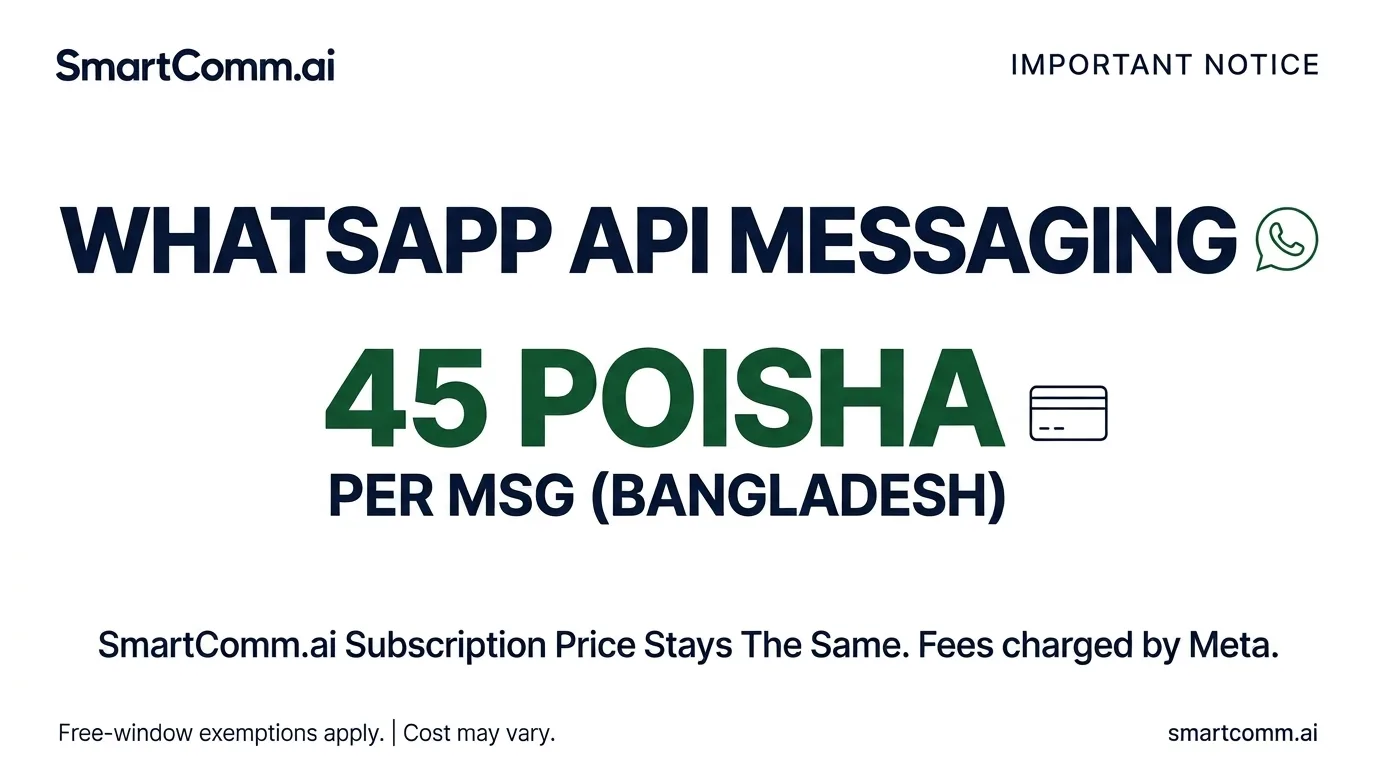
WhatsApp API pricing changes on 1 October 2026. Service replies become chargeable after free allowances and exemptions. For Bangladesh numbers, SmartComm uses an estimate of 45 poisha per paid service message. Our platform subscription fees stay the same.
Here is how to plan your budget, check payment setup and keep support helpful.
What changes in WhatsApp API pricing on 1 October 2026?
Meta will start charging for service replies and utility templates sent inside the 24-hour customer service window. Free-message rules still apply. Alibaba Cloud’s billing update confirms these changes for its WhatsApp service.
A service message is a normal reply to a customer. A utility template is a pre-approved message about an order, payment or other agreed task.
| Message type | Until 30 September 2026 | From 1 October 2026 |
|---|---|---|
| Service reply inside 24 hours | No Meta message fee | Charged after free allowances and exemptions |
| Utility template inside 24 hours | No Meta message fee | Charged unless exempt |
| Marketing template | Charged unless exempt | Charged unless exempt |
| Authentication template, such as a login code | Charged unless exempt | Charged unless exempt |
This changes which messages incur fees. It does not remove the rules on when you may contact a customer.
Will a WhatsApp message cost 45 poisha in Bangladesh?
About 45 poisha is a planning estimate for a paid service message delivered to a Bangladesh number. It is not a fixed price for all WhatsApp messages.
360dialog’s October rate table lists the Bangladesh service rate as US$0.0037 per message. Your final taka cost depends on the exchange rate and any other fees.
For WhatsApp API pricing in Bangladesh, check three things before you multiply a rate by your message count.
- Did the message reach the customer?
- Which message type applies?
- Which country or market does the recipient’s number belong to?
Use Meta’s rate cards for your final billing check. Marketing messages and some login-code traffic can have different rates.
Are the first 1,000 service messages still free?
Each business phone number gets 1,000 free service messages per month, according to YCloud’s September pricing update. The allowance resets each month and unused messages do not roll over.
It covers service messages, not every message type or 1,000 customer chats.
One customer can receive several replies. So a count of leads, tickets or customers will not tell you how much of the allowance you have used. Count delivered service messages for each business number.
Does the 24-hour window still mean free replies?
An open 24-hour window lets you send normal replies. It does not make all replies free from October. Your bill also depends on message type and free-message rules.
When does the reply window reset?
Each new customer message resets the 24-hour window. After it closes, you need an approved template to contact the customer again. The WhatsApp Business Messaging Policy explains this rule.
Keep the two checks separate. First, can you send this kind of message now? Then, is it exempt from Meta’s message fee?
That distinction matters for order updates, sales follow-ups and support replies.
How does the 72-hour free messaging window work?
An eligible ad or Facebook Page entry can open a 72-hour period with no Meta message-delivery fee. The customer must message you through that entry point, and you must reply within 24 hours. The 72 hours start with your reply.
Ads that click to WhatsApp open chats from Facebook or Instagram. The WhatsApp pricing overview describes the free entry-point benefit.
Does this also make the ad free?
No. You still pay for the ad. Other costs, including separate AI services, may also apply.
Use the window to answer questions and help a lead take the next step. Compare total ad and messaging costs before running a campaign just to save on replies. A normal website WhatsApp link does not, by itself, give every chat this exemption.
How can you estimate your monthly WhatsApp bill?
Count paid messages by type and the market you send to. Then apply the right rate. Keep your CRM fee separate.
The table below is an illustrative service-message budget. It assumes one business number, only Bangladesh recipients and no messages in an eligible 72-hour free window. It applies the 1,000-message monthly allowance and SmartComm’s rounded estimate of ৳0.45 per paid message.
| Delivered service messages in a month | Paid messages after the allowance | Estimated service-message cost |
|---|---|---|
| 1,000 | 0 | ৳0 |
| 5,000 | 4,000 | ৳1,800 |
| 10,000 | 9,000 | ৳4,050 |
| 50,000 | 49,000 | ৳22,050 |
For 10,000 messages, the calculation is 9,000 × ৳0.45 = ৳4,050.
This leaves out other message types, taxes, card fees, ads and SmartComm plans. For two or more business numbers, work out each number’s use on its own. Keep free messages separate so you do not deduct them twice.
Do you need to add a credit card in Meta Business Manager?
If your business pays Meta directly, check that your WhatsApp account has an active payment method. If a provider handles billing, confirm the setup with that provider.
What should you check before 30 September?
- Sign in to Meta Business Manager with the right account access.
- Select the business and WhatsApp account used by your team.
- Open its billing or payment settings.
- Add a supported card if needed, or check the existing payment method.
- Confirm that billing is ready for WhatsApp usage.
Menu names can vary. Make sure you check the WhatsApp billing setup, not just an ad account.
360dialog’s payment guidance reports that service delivery stops from October for affected providers or direct accounts without a payment method on file by 30 September. Ask SmartComm for help if you are unsure who handles your billing.
Will SmartComm subscription fees increase?
No. SmartComm’s platform subscription fees remain unchanged for this update. Meta’s WhatsApp usage charges are separate.
Your subscription pays for your SmartComm plan. Meta’s message fees depend on the WhatsApp traffic that qualifies for billing.
You can review our SmartComm plans and pricing to see your platform options. Add expected WhatsApp usage to your budget as a separate item so the two costs are easy to track.
How can you reduce message costs without making support worse?
Send complete, useful answers and cut duplicate replies. Keep the messages that help the customer solve a problem or make a decision.
Can one clear reply replace several fragments?
Yes. In an illustrative course enquiry, an adviser could share the fee, class times and booking link in one neat reply. That may replace three paid messages with one when the same billing rules apply.
At ৳0.45 each, those three messages would cost ৳1.35. One would cost ৳0.45. The example shows message-cost arithmetic, not a promised saving for every chat.
What else should your team review?
- Check chat history before asking for details again.
- Give each enquiry a clear owner.
- Remove duplicate greetings from staff and bots.
- Review pending follow-ups after an order is complete.
- Offer a call or web chat when it suits the customer and the task.
Calls and other channels can have their own costs. For more team tips, read our Bangla guide to reducing WhatsApp API costs.
How can SmartComm help your business prepare?
SmartComm.ai brings customer messages, calls, leads, tickets and customer records into one CRM. Your team can use that shared context to plan replies and follow-ups.
For an education team, that means checking what a student has already shared before asking again. For an online store, it means checking the order and chat before sending another update.
Our team can review your message volume and help you build a cost plan. Bring a recent usage report, the business numbers you use and the markets you serve.
If you use scheduled messages or AI, review those flows with your team. Check who sends each reply and what happens when a person takes over from a bot.
Use the SmartComm blog for product updates and team guides as you refine your process.
What else should you know about WhatsApp API pricing?
These answers cover common questions about costs and billing.
Does this apply to every WhatsApp user?
No. These are API charges. The WhatsApp Business app is a separate product.
Do incoming customer messages add to my bill?
No. Count paid outgoing messages, not total inbox activity.
Is 45 poisha the rate for marketing messages too?
No. Check the marketing rate for the market you send to.
Does my business number’s country set the service rate?
No. The recipient market sets the service rate.
Are replies from AI bots free?
No. Third-party AI replies can incur service fees plus AI costs. Check Meta’s pricing guidance for your setup.
Do unused free messages carry into next month?
No. The service allowance resets each month.
Do I need another card if billing already works?
Not always. Check that your current billing covers the right WhatsApp account.
Will moving to another CRM remove Meta’s charges?
No. Compare each provider’s full cost for the same message volume.
What should your business do before 1 October?
Check your payment setup, count your service replies and apply the free-message rules. Then help your team send clear answers with fewer duplicate messages.
SmartComm’s subscription stays the same. We can help you plan for Meta’s new charges.
Book a session with the SmartComm team and ask for a 10-minute WhatsApp cost review.